

Are Prices Crypto?
Bitcoin crashes and anxiety seizes the market. Here is why it will be alright.

Brogan Law provides top-quality legal services to individuals and entities with questions related to cryptocurrency. Cryptocurrency law is still new, and our clients recognize the value of a nimble and energetic law firm that shares their startup mentality. To help our clients maintain a strong strategic posture, this newsletter discusses topics in law that are relevant to the cryptocurrency industry. While this letter touches on legal issues, nothing here is legal advice. For any inquiries email info@broganlaw.xyz
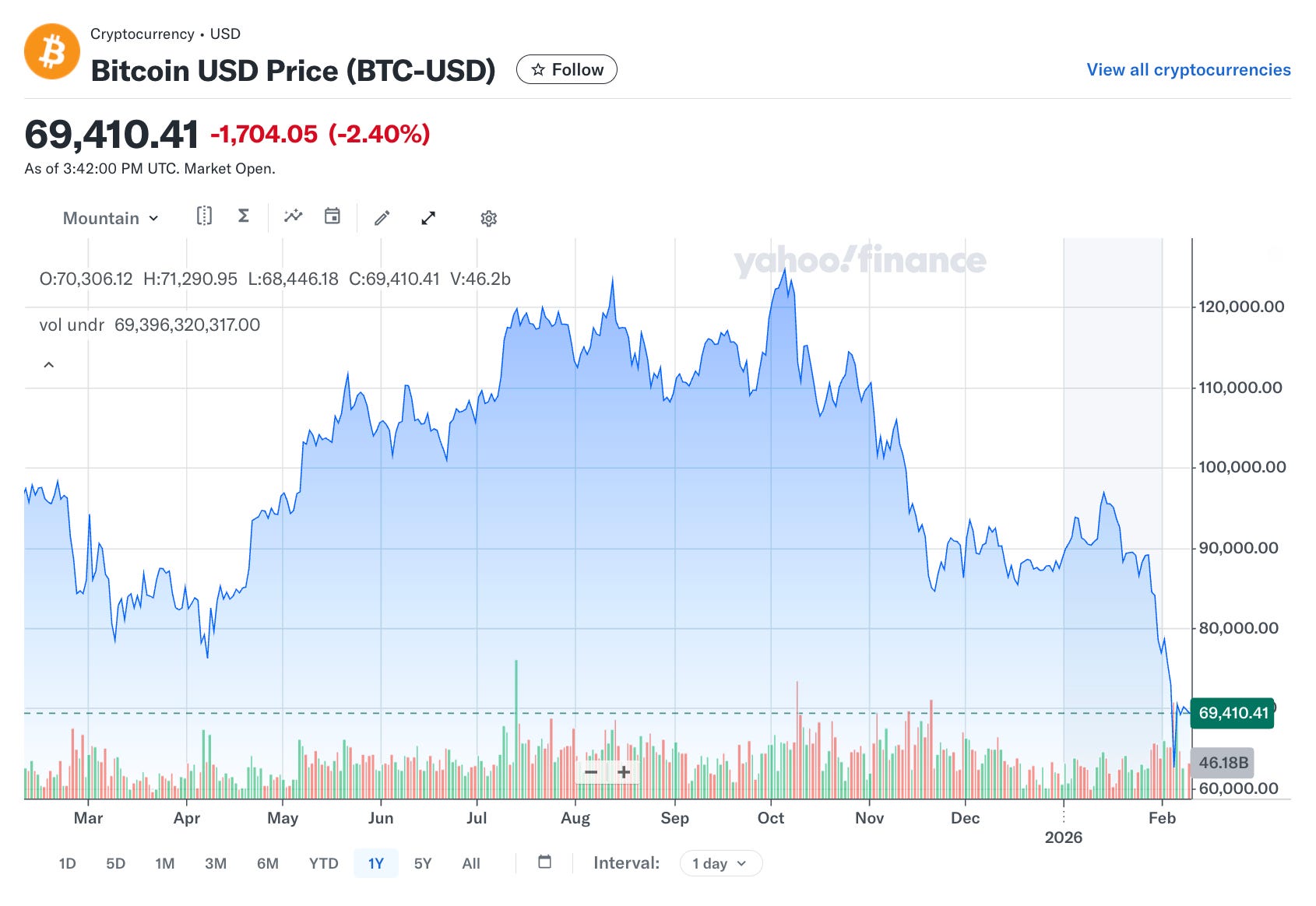
Last week, we experienced a pretty dramatic crash in cryptocurrency asset prices. Bitcoin, which had traded as high as $126,277 on October 6, 2025, crashed to a 52-week low of $60,230 on Wednesday, as part of a long downward trend without a single obvious catalyst.
I’ve written about these crashes before, and they are a real cause for alarm. When things go back, it has ripple effects, and often you start to see bodies washing up a few weeks later. So we have that to look forward to!

But that isn’t what I’m interested in this week. Instead, I want to cover the seeming pall that has descended over the crypto communities in recent months, and try to assess what it means. We make our living in the crypto industry here at Brogan Law, so there should be little doubt that we are biased, but that shouldn’t discount the force of my point today.
Token prices are a sentiment market, but crypto as an industry is the rails, regulation, and builders. Those are improving even as tickers fall. Crypto is OK.
Crypto Winter
Cryptocurrency is cyclical. Indeed, this is one of the defining features. If you go to X at arbitrary time=n, you’ll likely be able to find Martini Guy or some similar account talking about mega cycles, bulls, bears, etc.
For years, the vernacular of crypto winter, spring, and summer have suffused the dialogue around asset prices and helped normies understand what is happening in the markets. And everyone knows that these cycles are driven, at least in part, by sentiment.
It is almost a tautology to say that crypto asset markets are driven by sentiment, because for much of crypto’s history as an asset class, sentiment is all there was. Most crypto assets have no inherent value, they do not represent a claim against real world assets, there is no promise of future financial engineering to support their price, and all a purchase really represents is a bet that future purchasers will be willing to pay more for the asset.
And without fundamentals to evaluate, sentiment is contagious. See market go down, think something is driving it, sell. Easy. Indeed, one need not even assume that individual actors are behaving irrationally to arrive at this mechanism. If you, rational investor, expect the market to react to falling asset prices by selling, then you are incentivized to sell first.
This dynamic precipitates wild swings, which, oh yeah that is exactly what the crypto market has literally always done. Somehow, though, even though we all know this is how the crypto asset market works, every time we experience a downswing, en masse, the crypto community enters a depressive fugue state.
It’s all over, they say.
Well let me tell you. Soon, we’ll be so back. That is just how it works.
Wrestling with Chaos
I guess as people, one of our core cognitive functions is to attempt to derive meaning. The evolutionary psyche account of this goes something like, thought has instrumental value to the extent it correctly predicts outcomes, facilitating planning and strategy. For this reason, thought is the process of observing events and extrapolating patterns. We can surmise that those patterns will continue and use them. And when you’re really good at it, like humans are, you can really start cooking with gas.
Where this system breaks down is when causality is obscure, and especially in complex systems where it may not exist. Renaissance Technologies earned many billions of dollars distilling the ineffable into winning predictions, so one might speculate that there is deeper causality that humans can readily conceive, but at some level of abstraction we are simply unable to wrap our feeble little rat brains around big multi-variable systems. That’s when superstition arrives at the door. And that, I contend, is what is happening now.
This morning I was reading an Odd Lots newsletter from last week. Joe Weisenthal was listing off reasons why this crypto winter is different. Notwithstanding that this kind of media inevitably forms in a downturn for clicks if nothing else, it seems that Mr. Weisenthal sincerely believes that this time is different, and is trying to fit a model to that conclusion.
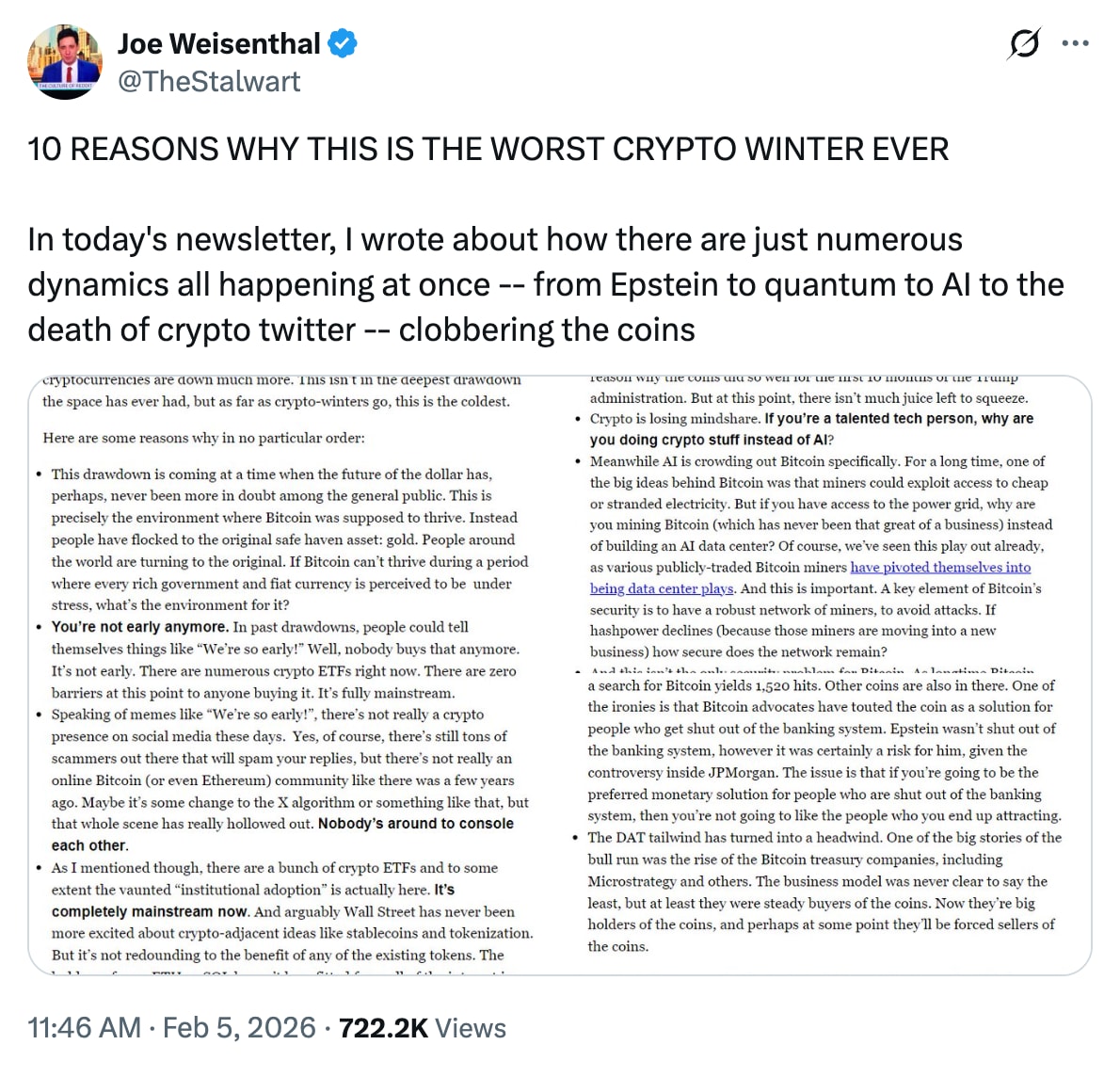
Some of the reasons might be meritorious, “In past drawdowns, people could tell themselves things like “We’re so early!” Well, nobody buys that anymore. It’s not early. There are numerous crypto ETFs right now” and “Meanwhile AI is crowding out Bitcoin specifically. For a long time, one of the big ideas behind Bitcoin was that miners could exploit access to cheap or stranded electricity. But if you have access to the power grid, why are you mining Bitcoin (which has never been that great of a business) instead of building an AI data center?”
But this is a commentary on crypto asset prices specifically, not the industry as a whole. When Mr. Weisenthal branches into that domain, I think the analysis is notably less sagacious. “Crypto is losing mindshare” is, sure, a valid critique, but many of his points, like “We have an incredibly crypto-friendly administration” and “It’s completely mainstream now” obviously cut the other way.
And that is the key, because in a chaotic system we simple pattern matchers try to fit the outcome we perceive to the facts presented. But we end up describing what is happening without analytical force. What are the facts on the ground? The cryptocurrency industry is experiencing its greatest regulatory acceptance ever, and asset prices are locally down. For Joe Weisenthal, this is a bad thing, because if you draw a causal relationship between events and asset prices, it seems that events can hardly improve, and so asset prices won’t either.
But what if asset prices are down simply because of contagion, or for no reason at all. If you view crypto asset markets as fundamentally chaotic and volatile, then the many trends in favor of the industry don’t have to form a constituent piece of your theory of current asset prices. Good things can just be good things.
Departures Aplenty
One phenomenon that has consistently appeared in crypto markets is that sentiment follows asset prices. Years ago I was talking to an editor at CoinDesk (long since departed) about their business. “Well it’s good you know, we just have the problem that when Bitcoin prices are down clicks fall off a cliff” they told me. And you can see that everywhere.
Particularly, in this cycle, as Bitcoin prices have fallen relatively consistently since their peak in October, there have followed a flood of departures from the industry.
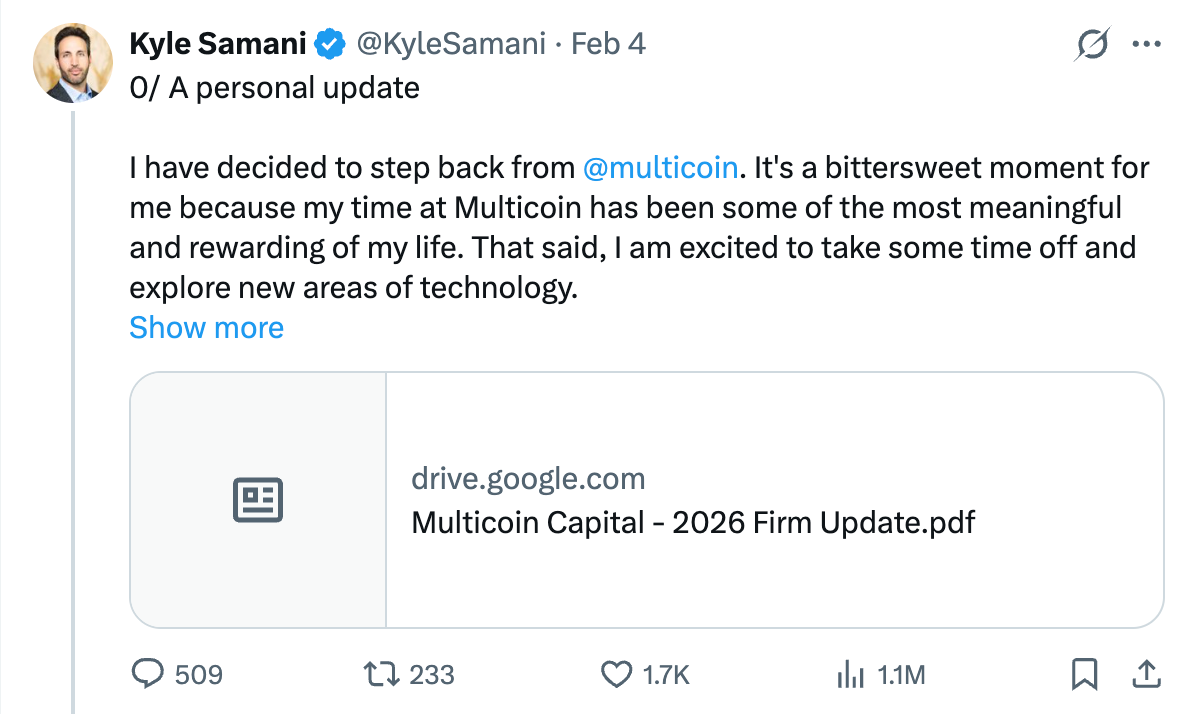
Most recently, Multicoin co-founder and highly influential Solana leader Kyle Samani announced that he would leave to focus on other things. This is a genuinely shocking turn at a firm that has been at the forefront of policy and novel technologies in the industry.
This is amidst a raft of other departures including our own Veronica Irwin. And it is hard to separate these from the broader context of depressed asset prices leading to low sentiment. People have interior lives and come and go for reasons of their own, but when the vibes are bad more of those people may pull the trigger. And maybe those departures push sentiment down further, depressing asset prices more in a vicious cycle.
The greatest real risk that this poses is that the many digital asset treasury companies (DATs) which sprung up during the recent bull will pop and tank prices even further as they do. These businesses often rely on levered buying and may face margin calls oh about any moment now.
But here is my core theory of this industry, and the real point. Even if the DATs do explode and tank all of our bags, prices are not reality. Yes, the basket of twenty or so tokens that constitute most retail crypto investments may not experience 10x gains from their recent all-time highs, but the actual work of building an industry continues, and that is what will ultimately continue the secular growth of alternative financial products that drew us here.
Most of our clients do not even have a token, don’t plan on launching a token. The prices of tokens, then, do affect VCs upside and ability to quickly realize liquidity, but are not a good barometer of the health of new growth in the industry as a whole.
The truth is, the regulatory environment has improved so dramatically so recently that the fruits of this change have not yet ripened. The GENIUS Act, as well as whichever of market structure or SEC exemptive relief eventually pertains, will dramatically widen the aperture of what is legally possible in the United States on crypto rails. This will lead to dramatic long-term secular growth of our industry.
When Joe Weisenthal writes that “arguably Wall Street has never been more excited about crypto-adjacent ideas like stablecoins and tokenization. But it’s not redounding to the benefit of any of the existing tokens. The holders of, say, ETH or SOL haven’t benefitted from all of the interest in crypto rails” he says it as if it were a bad thing. It may be true that a narrow band of legacy tokens won’t capture the value of future growth in this industry, but that is because, you, the founders, will.
We are an industry of builders, not of bagholders. And now in a moment of understandable anxiety, it is important to remember that. We are winning, for a year and change, everything that could go our way has gone our way, and that means that we will be able to build more and more. But a ticker changes in an instant and that takes time, so it is a harder story to tell.
Until next week.
Brogan Law is a registered law firm in New York. Its address and contact information can be found at https://broganlaw.xyz/
Brogan Law provides this information as a service to clients and other friends for educational purposes only. It should not be construed or relied on as legal advice or to create a lawyer-client relationship. Readers should not act upon this information without seeking advice from professional advisers.