


Brogan Law provides top-quality legal services to individuals and entities with questions related to cryptocurrency. Cryptocurrency law is still new, and our clients recognize the value of a nimble and energetic law firm that shares their startup mentality. To help our clients maintain a strong strategic posture, this newsletter discusses topics in law that are relevant to the cryptocurrency industry. While this letter touches on legal issues, nothing here is legal advice. For any inquiries email info@broganlaw.xyz
Editor’s Note: please welcome a new guest writer to the newsletter. Extremely pleased to be able to work with Daniel Kuhn. Here is what he is about:
Daniel Kuhn is an award-winning journalist and editor, formerly deputy managing editor for features and opinion at CoinDesk, where he oversaw longform packages, columns and the opinion desk. He now works independently as a freelance writer and editor and is available for contract assignments in ghostwriting and editorial work.
Sunlight Illuminates the Dark
In a few hours, the CLARITY Act will come up on the Senate floor for cloture. Cloture is a process by which the Senate decides if it will consider a bill, and critically, it is a procedural predicate to voting on the law itself. Senate procedure is tricky, but cloture will require 60 votes to pass, and the bill itself, assuming JD Vance is onside, will take 50. According to prediction market Kalshi’s implied odds, CLARITY will more likely than not fail.
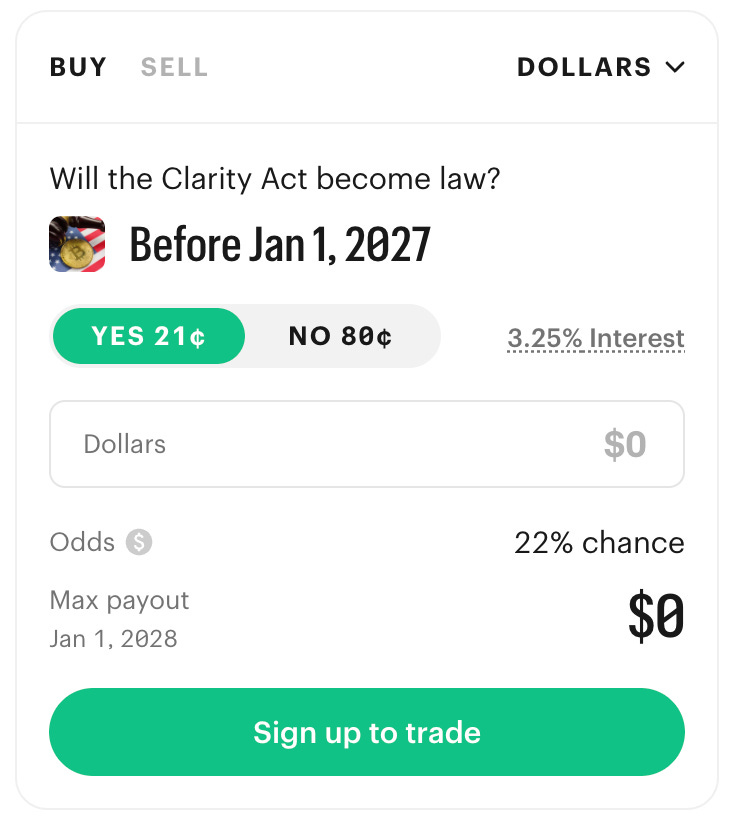
Source: Kalshi
In the bill’s death throes, as advocates bargained away larger and larger chunks of the bill to win Democratic support, a draft circulated late Sunday cut a piece of language that had long been critical to the DeFi community. If the bill does die for good today, that’s the part we would bring back. The Blockchain Regulatory Certainty Act (BRCA).
Many of you may already be familiar, but for those out of the loop, the BRCA is a targeted provision designed to shield non-custodial crypto developers and infrastructure providers from regulatory frameworks built for traditional banking systems. Specifically, it is designed to protect individuals and protocols that never hold or control user funds from money transmission law, a common-sense stance that FinCEN itself has historically acknowledged.
Money transmission is an innocuous doctrine with big consequences. Under 18 USC 1960, it is a crime to engage in it unlicensed. The go-to-jail kind. That is what the BRCA would guard software developers against, at least until Sunday.
In last-minute negotiations before today’s Senate cloture vote, drafters gutted the BRCA’s most important piece. While overall, the BRCA keeps its civil and regulatory safe harbor so that non-custodial developers, miners, and validators who never control user funds are not treated as money transmitters under the Bank Secrecy Act and FinCEN rules, it also deleted the explicit shield against criminal liability under 18 USC 1960, the element that advocates had long treated as the bill’s core protection.
It makes sense that software developers should not be culpable for later, illegal and unintended, uses of their products. So, historically, BRCA has received strong bipartisan support. In fact, lawmakers on both sides of the aisle have advocated for some version of the BRCA’s protections since at least 2017, when forward-looking Representatives Tom Emmer (R-MN) first introduced legislation.
“We usually limit [regulation] to people who put themselves in a position of trust vis-a-vis a user of their tools,” Peter Van Valkenburgh, of Coin Center, a longtime champion for the BRCA, said in an interview. “A software developer who just publishes open-source software, a miner or a node … is just maintaining pipes.”
Non-political entities have long recognized this distinction, too. In its 2019 guidance, FinCEN drew a line around money transmitters that explicitly excluded non-custodial software developers. And yet, in the decade since the BRCA was first drafted, a wave of aggressive enforcement has blurred those boundaries.
This includes the federal criminal cases against the developers of protocols like Tornado Cash, Samourai Wallet and various other decentralized privacy tools that treated writing open-source code as the functional equivalent of running an underground bank.
This is exactly why advocates of BRCA believe it should continue to be championed if CLARITY fails. Without a statutory check, the Justice is free to pursue whatever theory it chooses, ignoring administrative guidance. This can make it unpredictable and difficult for developers to plan or come into compliance, chilling progress. That’s why, if CLARITY dies, BRCA should rise again.
The Fight is Won
Passing legislation is notoriously difficult, and writing a comprehensive market-structure bill for a controversial financial sector is an immense challenge. But because the BRCA carries narrow aims, boasts bipartisan and nonpartisan backing, and has been refined through years of revision, it could easily find a home in other must-pass legislative vehicles, such as the National Defense Authorization Act (NDAA).
Van Valkenburgh noted that the impetus behind the BRCA a decade ago was the growing realization that non-custodial, decentralized systems, which let users interact peer-to-peer or via autonomous code, clashed with overbroad and ambiguous money transmission laws.
“We wanted it clear that you’re not going to be obligated to license either at the state level or at the federal level — and do AML-KYC — if you’re just building infrastructure or software for crypto and you don’t have control of other people’s money,” he said.
“Why you’d want to license software developers in this country, I don’t know. It would be kind of un-American,’ Van Valkenburgh added.
The BRCA has been refined significantly over the years, particularly after being tethered to CLARITY as its primary legislative vehicle. Lawmakers have successfully addressed early criticisms, including fears that exempting non-custodial entities from money transmission laws might shield bad actors. As a result, several law enforcement groups including the National Fraternal Order of Police have shifted from opposing the bill to neutral or supportive stances.
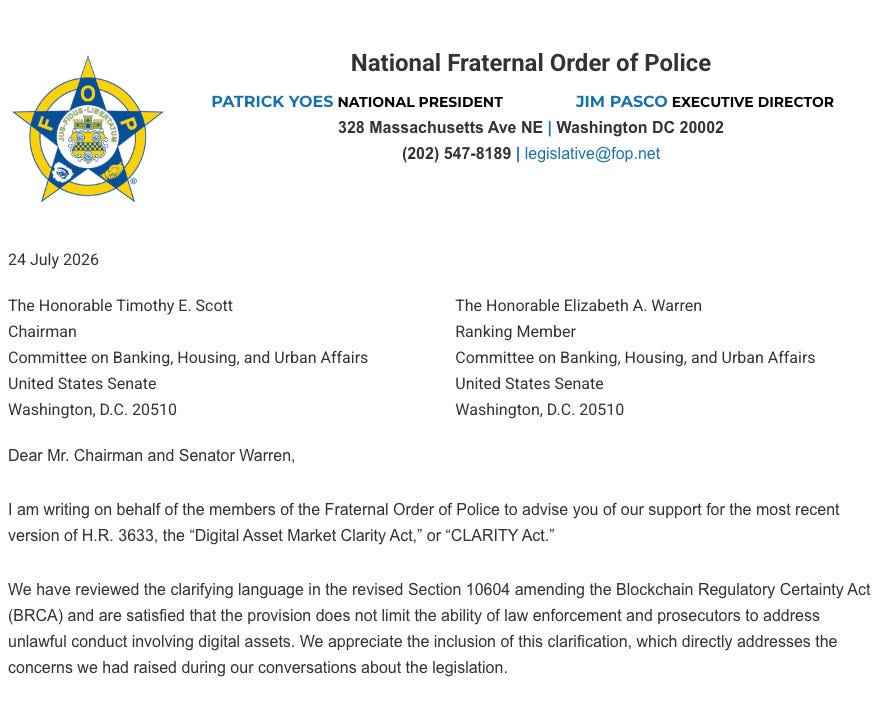
Most notably, after Senate Banking Committee review, legislators have drilled down on how the bill interacts with 18 U.S.C. 1960 and other parts of the criminal code, ensuring that its safe harbor protections do not block persecution of people who, with specific intent, transfer funds they know to be derived from crime or are intended to support unlawful activity.
“We saw a lot of hyperbole about how criminals are going to have an easier time moving dirty money around if the BRCA becomes law,” Patrick Wilson, general counsel of Solana Policy Institute, said. “It’s not supposed to immunize all criminal conduct related to crypto.”
That point was echoed by Blockchain Association Chief Policy Officer Lindsay Fraser, who noted the “BRCA does nothing to alter any of the criminal code as it pertains to money laundering, fraud, sanctions, evasion or other anything that is a crime in terms of the transmission of money.”
She pointed to the case against Tornado Cash co-creator Roman Storm, who was charged with unlicensed money transmission as well as conspiracy to launder money and evade sanctions — the latter charges of which the BRCA would not wipe away, leaving prosecutors free to pursue “intent-based crimes” if they can prove them.
“The only thing it does is just clarify, if you are the developer of a protocol that is non-custodial, non-custodying, then the developer his or herself cannot be found to be criminally liable for being a money transmitter,” Fraser said. “That’s because they’re not transmitting the money.”
Future Proofing
Given the pace at which the crypto industry has evolved, it might be fair to question whether a bill rooted in legislation from 2017 can adequately address modern technological breakthroughs and other product innovations.
The provision, for instance, has been rewritten to address mounting concerns around onchain stocks, which saw a degree of adoption this year and are forecasted to see continuing growth. Earlier drafts included broader language that could have let non-custodial broker-dealers in tokenized securities slip out of Bank Secrecy Act (BSA) reporting and record-keeping duties.
The House Financial Services Committee has revised the text to limit the BRCA’s carve-out so that relevant firms are exempted only from money-transmitter status, not from the BSA’s wider “financial-institution” category. That means tokenized securities platforms may still be subject to core AML, customer-identification and reporting duties that already apply to traditional broker-dealers.
Similarly, zero-knowledge proofs and autonomous AI agents are challenging conceptions of self-custody and self-execution as new products come online.
Like other non-custodial tech, ZK protocols rely on advanced cryptography to verify transactions trustlessly. The developer writes the math, but execution is entirely autonomous and decentralized. But as AI agents begin managing wallets and submitting transactions onchain, the line between “user,” “tool” and “creator” might blur.
“The great thing about the BRCA is that it’s pretty much technology neutral,” Van Valkenburgh said. “It says that the thing that matters... the reason why we obligate some people to surveil their customers... is because they’re already in a relationship with their customers.”
This may or may not be true for AI, which can use many different custody setups. “The operative question from a should-you-be-regulated-or-not standpoint is still, are you putting yourself in a position of trust,” he added.
Can it be Saved?
As it stands at time of writing, things look dire for CLARITY. Nobody knows what will happen in the Senate today, but market observers see this as the last gasp for the troubled bill.
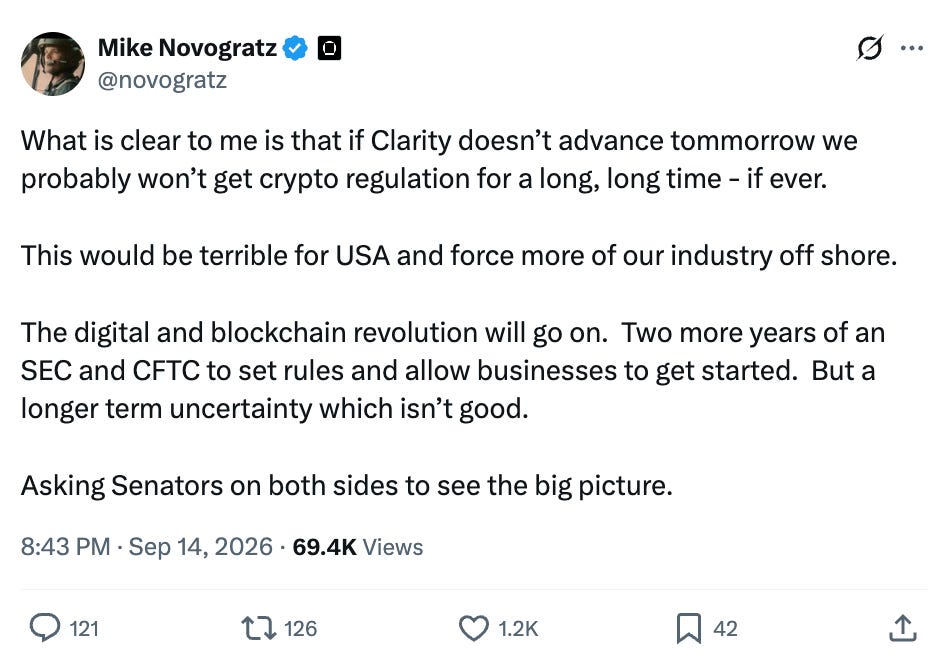
But maybe the death of one bill is a chance at new life for another. Today doesn’t have to be the end of BRCA.
Brogan Law is a registered law firm in New York. Its address and contact information can be found at https://broganlaw.xyz/
Brogan Law provides this information as a service to clients and other friends for educational purposes only. It should not be construed or relied on as legal advice or to create a lawyer-client relationship. Readers should not act upon this information without seeking advice from professional advisers.
