

Stocks on Blocks
If Robinhood has its way, equity securities are coming onto the blockchain.


Brogan Law provides top-quality legal services to individuals and entities with questions related to cryptocurrency. Cryptocurrency law is still new, and our clients recognize the value of a nimble and energetic law firm that shares their startup mentality. To help our clients maintain a strong strategic posture, this newsletter discusses topics in law that are relevant to the cryptocurrency industry. While this letter touches on legal issues, nothing here is legal advice. For any inquiries email info@broganlaw.xyz
43.5514° N, 7.0128° E
Short newsletter this week, as I am at an undisclosed location on the Mediterranean, but a major advancement in the ongoing convergence of cryptocurrency and traditional securities markets came to a head just down the road last week.
In parallel to the popular EthCC conference in Cannes, the fintech firm Robinhood held its own Southern France-based event, announcing the launch of what it called “Stock Tokens.”
CEO Vlad Tenev took the stage in a pinstriped white suit and cravat1 and breathlessly broke down the project's thesis and backend. This product, currently only available outside of the United States, will create and burn tokens representing shares of equity securities. For those curious how this kind of program might work technically, the details will be interesting.
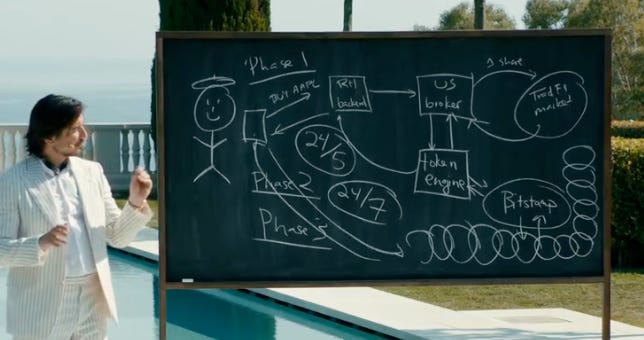
In “Phase One,” which is currently active in the EU, Robinhood takes orders for US public equities through its front end and then transmits them to a US broker, who then fills the order on public equity markets in the United States. From that point, until the token is burned, the US broker will retain custody of the equity itself.
At the same time, however, the Robinhood token engine will create a token to represent custody of the equity and send that token to the user.
In this first phase, the user won’t be able to do much with that token, but future iterations are explicit. In “Phase 2,” Robinhood plans to allow trading outside of traditional trading windows, by accepting the order, minting the token, and backfilling later. Then, the holy grail, they will allow the tokens to trade freely off of their own platform. At some point along the way, they plan to make all of this available in the United States as well.
I said that the last iteration is the “holy grail” because it amounts to a reordering of global secondary equities markets. Right now, trading in US public equities is highly balkanized by the extremely complex regulatory requirements like Reg NMS. This is expensive and limiting in time and global reach. Robinhood asks: what if we didn’t do that?
In addition, Robinhood has also offered some private equities in this tokenized form. For now, they are giving away tokens representing SpaceX and OpenAI2, but in the long term they clearly plan to sell them. And this, too, would be an evolution of current market standards, where private securities are generally inaccessible and illiquid.
Writing for Bloomberg this week, financial commentator Matt Levine placed this in a broader debate about the roles of public and private markets, arguing that tokenization will erase the difference by, roughly, ignoring the rules as they currently exist:
There is, however, a more extreme approach: Just get rid of the public-company rules. Let anyone sell stock to the general public without any disclosure or audited financial statements. The general public can make up its own mind: If someone wants to sell you stock, and you want to buy it, you can buy it. If you want audited financial statements, you can ask for them; if the company says no, then you don’t have to buy the stock. (But you can!) Fraud would still be illegal — if they give you fake financial statements, you could sue, or call the police — but the whole apparatus of required disclosures would become optional. Companies could follow the current US securities laws, filing audited financial statements and annual reports and public updates, if they thought that would help them raise more money at a higher valuation. But if they didn’t want to, they wouldn’t have to, and they could still sell stock to anyone who wanted to buy.
You do not hear a lot of people explicitly advocating for this approach.
Wrong, Matt! I have been publicly advocating for this kind of development for some time, most notably in my January CoinDesk op-ed Put Securities On-Chain!, where I wrote:
I call it a regulatory third way. Sitting between exempt securities and public offerings, the SEC should promulgate rules that allow projects to sell securities in the form of cryptocurrency tokens with limited compliance and disclosures – combining the relative simplicity of a private placement with the secondary liquidity of a public offering.
Now, six months later, it's really happening. Probably. Maybe. Let's see.
SIFMA’s Plight
Robinhood got the most attention because Mr. Tenev dressed up as a Bond villain for his announcement, but crypto platforms have been demoing comparable products for some time now.
Coinbase reportedly sought no-action from the SEC for a similar program in June, and Kraken launched its own tokenized equity model called xStocks in non-US markets in May.
Now, the fact that firms are reaching out does not in itself suggest that the SEC is likely to grant these requests. As Mr. Levine points out, doing so could dramatically reorder the administration of capital markets.
The real prize is that if you utter the magic word “tokenized,” that could let you sell private stock to the general public. It could let companies sell stock to the general public without complying with US disclosure rules. That is what it means. It means that the US securities laws that were put in place in the 1930s, that require companies to make public disclosures about their businesses to raise money from the general public, will no longer apply.
But there are some indications that it might. SEC Chair Paul Atkins, perhaps the world’s single most influential person in the regulation of these products, went on CNBC’s Squawk Box and, asked if tokenization was a “workaround” to the rules, replied “well, I guess I disagree with that. Tokenization is an innovation, and we at the SEC should be focused on ‘how do we advance innovation in the marketplace?’” Bullish!
At the same time, the legacy securities industry is growing nervous about the groundswell. SIFMA, the Securities Industry and Financial Markets Association, is an industry group charged with advocating for the interests of existing entities operating in the securities industry. They filed a comment letter with the SEC Crypto Task Force back in May arguing that the SEC should exercise prudence and “apply existing and well-understood securities regulatory principles to digital assets rather than creating a distinct architecture for this class of assets and transactions.”
In the interim, however, these burgeoning developments seem to have perturbed them, because they filed another letter on June 30 advocating against alleged requests for exemptive relief from firms like Coinbase and (probably) Robinhood. The no-action requests they reference are not yet public3, but it is clear from the letter that they believe a number of major players have been making moves to create tokenized equities programs in the United States, and are nervous that these will be approved.
SIFMA members have been reading with significant concern recent reports indicating that certain digital asset firms have submitted requests for immediate no-action or exemptive relief from requirements under the federal securities laws to allow such firms to offer investors the ability to purchase and trade tokenized equities or other digital forms of traditional securities through the firms’ platforms.
At the same time, players in the tokenization space have been making moves to position for coming changes. Tokenization firm Ondo Finance announced a deal on July 4 to purchase the regulated entity Oasis Pro. If approved, the deal will give Ondo access to a number of crucial licenses to operate a tokenized stock model like Robinhood and Coinbase. The most relevant of these being a broker-dealer registration and alternative trading system (ATS) designation.
Ondo thinks it's coming, SIFMA thinks it's coming. Ask Chair Atkins, he thinks it's innovation. Methinks it's coming.
Legality is a Warm Gun
Legality is not binary in securities regulation. There is essentially no chance that the SEC releases sweeping no action that will allow private securities to trade publicly to anyone with a wallet. What is far more likely is that Mr. Atkins and co agree to a gradual liberalization of the technical restrictions on trade. That is why firms like Ondo are considering picking up ATSs.
An ATS is essentially an analog for a traditional exchange, matching buyers and sellers, but within a narrower regulatory sandbox. It’s a way to legally facilitate secondary trading of non-public securities without requiring the full regulatory suite of a larger vehicle.
Most ATSs have not gained major traction as a forum for retail trading, with only roughly 8% or less of all trading volume occurring on the platforms. But that could change. As the securities laws are liberalized, more trades will be effected outside of the traditional customer-broker-national exchange/market maker path. Instead, novel models will develop within the ATS framework.
However, there are still limitations, and the final piece of the puzzle has still not gained enough traction to manifest. Only accredited investors can trade on an ATS. Right now, only roughly 20% of households are accredited, and so this is a fundamental speed-brake on the development of private tokenized securities markets.
This is why Matt Homer and I proposed reforming the accredited investor rule in CoinDesk in March. The SEC is unlikely to go all the way and liberalize the free trade of equity tokens on public markets, but it might do so for accredited investors. That makes the definition of accredited investor the crucial unlock for the entire system to work.

Right now, there are three key ways to become an accredited investor. First, you can earn $200,000 or more in income for two years in a row. Second, you can have a net worth of greater than $1,000,000, excluding your home. And third, you can test in.
It’s this third option that is the focus of our proposed reform. Sec 2(a)(15)(ii) of the Securities Act of 1933 defines an accredited investor to include “any person who, on the basis of such factors as financial sophistication, net worth, knowledge, and experience in financial matters, or amount of assets under management qualifies as an accredited investor under rules and regulations which the Commission shall prescribe.” This empowers the SEC to rely on tests to identify accredited investors.
And so, in August 2020, they did, by adding:
a new category to the definition [of accredited investors] that permits natural persons to qualify as accredited investors based on certain professional certifications, designations or credentials or other credentials issued by an accredited educational institution, which the Commission may designate from time to time by order. In conjunction with the adoption of the amendments, the Commission designated by order holders in good standing of the Series 7, Series 65, and Series 82 licenses as qualifying natural persons.
This press release doesn’t say it, but this category of natural persons is persons who passed tests, the Series 7, Series 65, and Series 82 tests. These tests are professional qualification exams for brokers and investment advisers, and not just anyone can take them, you have to be sponsored by a regulated entity.
And when it comes down to it, that is what we propose changing. Let anyone take the tests and become an accredited investor. You could change the tests too, to make more sense for retail, but you needn’t do so to have the desired effect. That’s fairness, and opening up the private markets to anyone with “sophistication, knowledge, and experience in financial matters” to participate, just like the law says. Any American should have a chance, regardless of their employer or wealth.
I think this is a simple and appealing policy. It will make capital markets fair again, and, as you have seen, if it allowed more Americans to participate in capital markets, it could unlock a wave of tokenized equities and remake those markets for this modern age. We’ll have to hang up the revolution for this week though, it's dinner time!
Until next week.
Brogan Law is a registered law firm in New York. Its address and contact information can be found at https://broganlaw.xyz/
Brogan Law provides this information as a service to clients and other friends for educational purposes only. It should not be construed or relied on as legal advice or to create a lawyer-client relationship. Readers should not act upon this information without seeking advice from professional advisors.
I’m not hating — you looked great Vlad!
The SIFMA letter references multiple requests but only calls out Coinbase specifically. It seems likely that at least Coinbase, Robinhood and Kraken have requested relief, and perhaps Ondo Finance and others as well, however this is unconfirmed speculation.